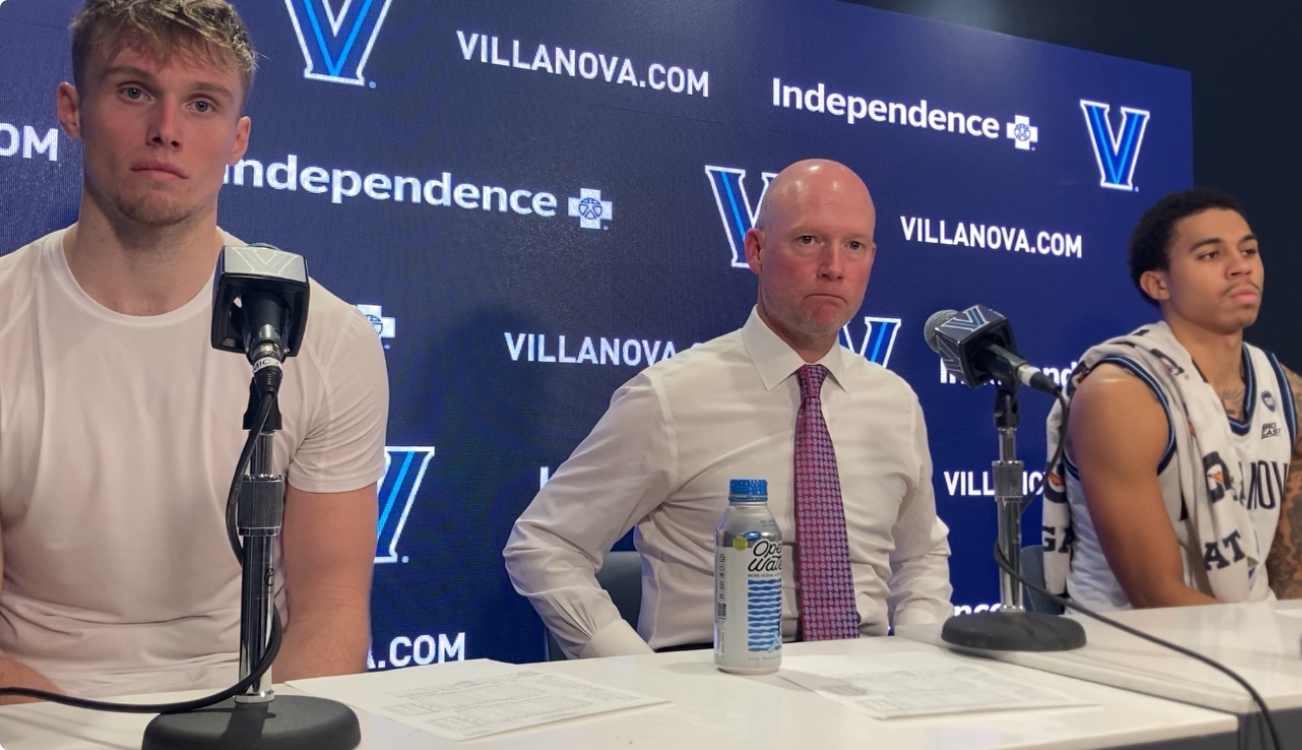
Villanova's (l-r) Duke Brennan, coach Kevin Willard, and Bryce Lindsay speak at a press conference following Saturday's 79-61 win over Pitt. (Photo: Aaron Bracy)
By AARON BRACY
Big5Hoops.com
January 4, 2026
After three straight seasons of missing the NCAA tournament, Villanova is back on track to being, well, Villanova in the first year under coach Kevin Willard.
The Wildcats’ latest feel-good win came on Saturday when they used a dominating second half to coast to an 85-67 rout of Butler at Hinkle Fieldhouse, improving to 12-2 overall and 3-0 in the Big East. The victory had several national pundits gushing about Villanova.
There is a good chance that the Wildcats will be ranked in the Associated Press Top 25 when the latest poll is revealed on Monday. They are among the best teams in the country in two key metrics, ranked No. 25 in the NCAA Net Rankings and No. 21 in KenPom.
It has been a quick transformation under Willard. Remember, this was a Villanova team that got bounced by Columbia at home last season while finishing third in the Big 5, one year after losing at Penn, at home to Saint Joseph’s, and on a neutral floor to Drexel to finish sixth out of six in the Big 5.
The Wildcats still have a long way to go–17 tough Big East regular-season games, in fact–before anyone can take a deep breath and exhale the NCAA tournament drought and fully declare Villanova back as a team of national prominence again. There are no prizes given for a fast start or looking good through two months of the season as Villanova has. Still, the Wildcats are looking again like the Wildcats and people are talking about them in a way that fans on the Main Line became accustomed to under Jay Wright.
So, how has Willard done it? Here are three ways:
1) Roster Construction: While the transfer portal provides a unique opportunity to get good quickly, it is not a simple task to assemble the right pieces. We have seen that at Villanova in the last two seasons and many other places.
On paper prior to the season, Willard’s roster didn’t overwhelm you. But the coach knew what he needed to match his style of play and recruited players who would be a good fit to his system and with each other.
Willard knew he needed shooters and nabbed a pair of under-the-radar players in Bryce Lindsay and Devin Askew.
Lindsay hit 87 three-pointers at James Madison last season as a sub, but you wondered how that would translate at the Big East level. The answer has been a definitive “really well,” as Lindsay is shooting 44.7 percent from long range while leading Villanova in scoring at 16.9 points per game.
Askew has connected on 40.4 percent from beyond the arc. In addition to shooting, he brings scoring and experience in big-time environments, as he is playing in his sixth college season after stops at Kentucky, Texas, Cal, and Long Beach State, where he averaged 18.9 points in 36.1 minutes last season.
When Butler coach Thad Matta was asked what Villanova did differently in the second half on Saturday when they made 6 of 9 three-pointers after missing 11 of 12 in the opening 20 minutes, he said, “They moved back a little bit farther.”
Willard knew he needed rebounding and brought in Duke Brennan, who has averaged 11.3 rebounds in addition to 12.0 points. Brennan had impressed the coach last season in the first round of the NCAA tournament (and likely in his pregame film study) when he grabbed eight rebounds in 23 minutes for Grand Canyon in an 81-49 loss to Willard’s Maryland team on March 21, 2025. Brennan also brings certain intangibles that any good team needs, including toughness.
Willard’s prize acquisition was freshman Acaden Lewis, who originally was committed to Knetucky and chose the Wildcats over Georgia, St. John’s, and Miami after re-opening his recruitment. He continues the pipeline of talent from Washington, D.C.’s Sidwell Friends to Villanova, following Josh Hart and Saddiq Bey. Lewis has been as advertised, averaging 12.0 points, 3.6 rebounds and a 4.9-to-1.6 assist-to-turnover ratio. He has flashed some exciting moves, such as his second-half drive past Butler’s Yame Butler for a layup on Saturday.
Then, Willard retained key pieces Tyler Perkins and Matt Hodge. Perkins does a little bit of everything and is the Wildcats’ best defender. He averages 10.9 points, 5.1 rebounds, 1.8 assists, 1.0 steals and shoots 38.1 percent from three-point range. Hodge, who was forced to sit out last season at Villanova due to an NCAA decision over high school credits, is giving 10.8 points and 4.4 rebounds and hit a pair of key three-pointers against the Bulldogs on Saturday in the second half.
Other than Lewis, Willard’s tight, seven-man rotation weren’t the biggest names before the season tipped off. But the coach saw the fit, and all have made names for themselves to this point.
2) In-game coaching: A good coach has to be so many things, and it is hard to pinpoint exactly what has made Willard so successful to this point. But here are three examples of what, to me, is great coaching.
As talented as Lewis is, he is still in his first year of college basketball in an era where players are older and more experienced than ever. In the Wildcats’ season-opening 71-66 loss to BYU, Willard benched his star freshman for the final 14:55. Most recently, in Villanova’s 71-66 home win over DePaul on New Year’s Eve, Lewis didn’t play for the final 10:54. Two things here: 1) It takes conviction to recognize that the moment or the matchups aren’t right for one of your best players and then sit him. 2) It takes a lot of behind-the-scenes work to coach up the player, especially a young player, to avoid any hard feelings or hurt in confidence. In both cases, Lewis bounced back strong, which is a credit to both the player and the coach.
Tactically, Willard’s switch to a 2-3 zone with the Wildcats trailing DePaul by 10 points with 11 minutes remaining after the Blue Demons were giving Villanova fits with their high ball-screen pick-and-roll action was a savvy move. “We had to take that away,” Willard said.
There were two more instances on Saturday of Willard directly impacting the contest when he twice called for isolation plays against Butler’s Finley Bizjack, with Perkins getting an easy layup the first time and Hodge the second occurrence. These are just two examples but important ones to highlight as evidence.
3) Authenticity: One of the biggest challenges of following in the footsteps of a legend is doing things differently than the person who had success. Wright’s accomplishments at Villanova are superlative, with two national titles and four trips to the Final Four.
Obviously, Willard would love to have similar success, but he is not trying to be Wright. One big example is how he communicates to fans through the media.
In contrast to Wright, Willard is more animated, entertaining, and sometimes off the cuff in postgame press conferences. It’s most important, obviously, what happens on the court, and the way Willard communicates after games is being presented here only to highlight a difference with Wright and also because communicating in this way indicates that Willard is comfortable being Kevin Willard. There is an authenticity about him that is important, especially entering a situation in which another coach had so much success doing things a certain way.
A few examples:
-After the Wildcats’ 64-56 win at Seton Hall on Dec. 23, Willard both lashed out at the NCAA for its eligibility policies and dropped an F-bomb while joking with a pair of Seton Hall beat writers.
–Following Villanova’s 79-61 win over Pitt on Dec. 13, Willard drew laughs when inviting writers to have a beer with him to show he was a good guy when asked from where he got his hard edge.
-He excused Villanova’s shaky first-half defense and poor free throw shooting against DePaul to Christmas cookies. “Sometimes you eat too much Christmas cookies, your free throw shooting goes to shit.”
-After Saturday’s win at Butler, he good-naturedly cut off Villanova’s sports information director who asked about Lewis: “Why are you asking me questions?” The response was that the question was sent in by a Villanova beat writer. “Then they should be here.”
In some ways, Willard reminds of another Philadelphia coach who had a lot of success coaching down the road from Villanova who was animated, entertaining, and sometimes off-the-cuff in press conferences. Of course, I’m talking about Phil Martelli.
Ultimately, Willard will be judged on what happens between the 94 x 50 feet on the court and not what he says and does in a media room. Still, the fact that Kevin Willard acts and talks in a way that is Kevin Willard says a lot about why he is having success to this point at Villanova.
Add that with his roster construction and in-game coaching and you have good reasons why Villanova is back on track to being Villanova.
—
Aaron Bracy has covered sports in Philadelphia for nearly three decades for various publications and as a freelancer for the Associated Press. His first book, A Soaring Season: The Incredible, Inspiring Story of the 2003–04 Saint Joseph’s Hawks (Brookline), can be ordered HERE. He is working on his second book, which will chronicle the memorable 2000–01 season of Allen Iverson and the Philadelphia 76ers. It will be published in April 2027. Follow Bracy on social media HERE. Contact him at bracymedia@gmail.com.
—
Correction: An earlier version of this story stated that Villanova missed the NCAA tournament in two straight seasons. It has been corrected to three straight seasons.